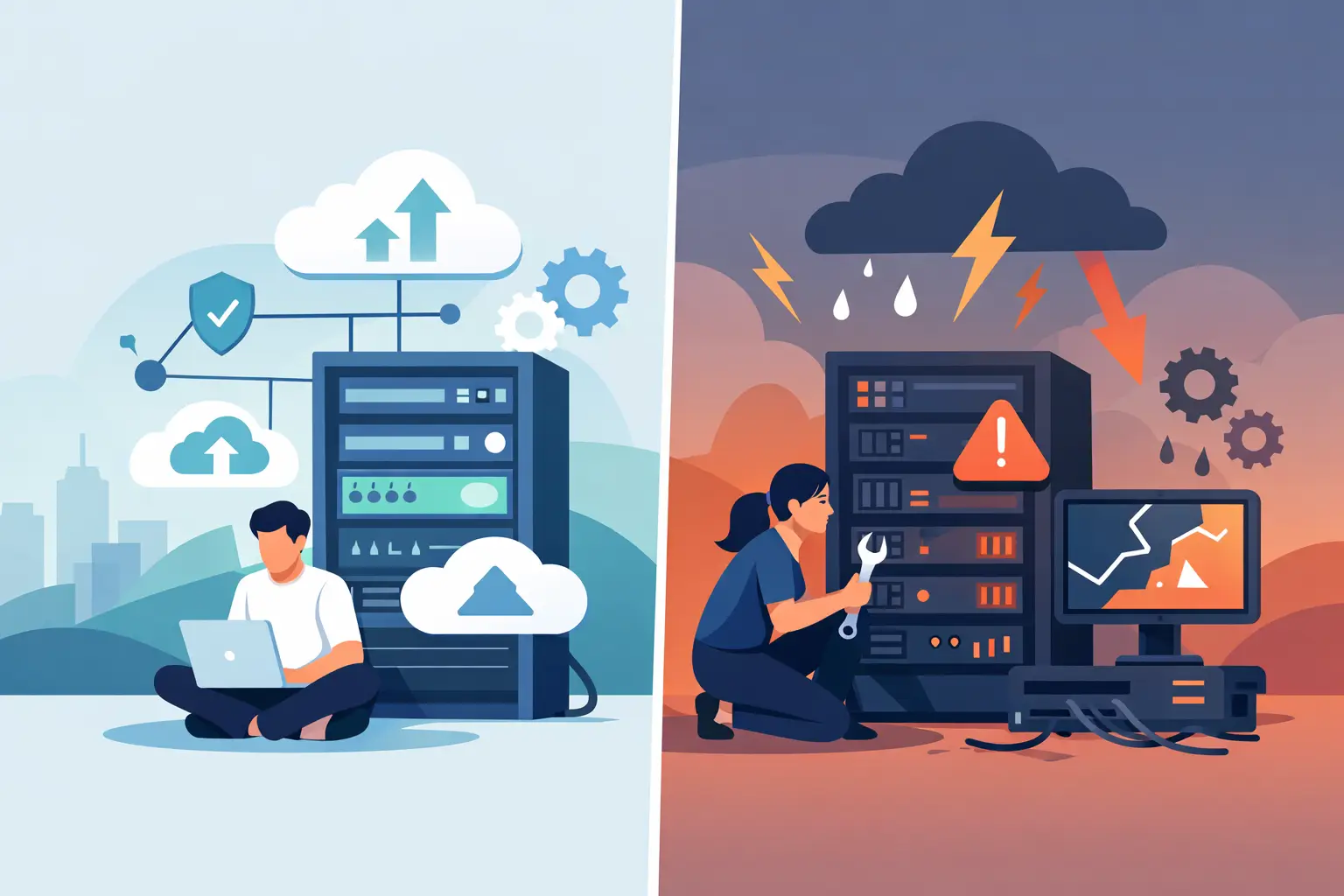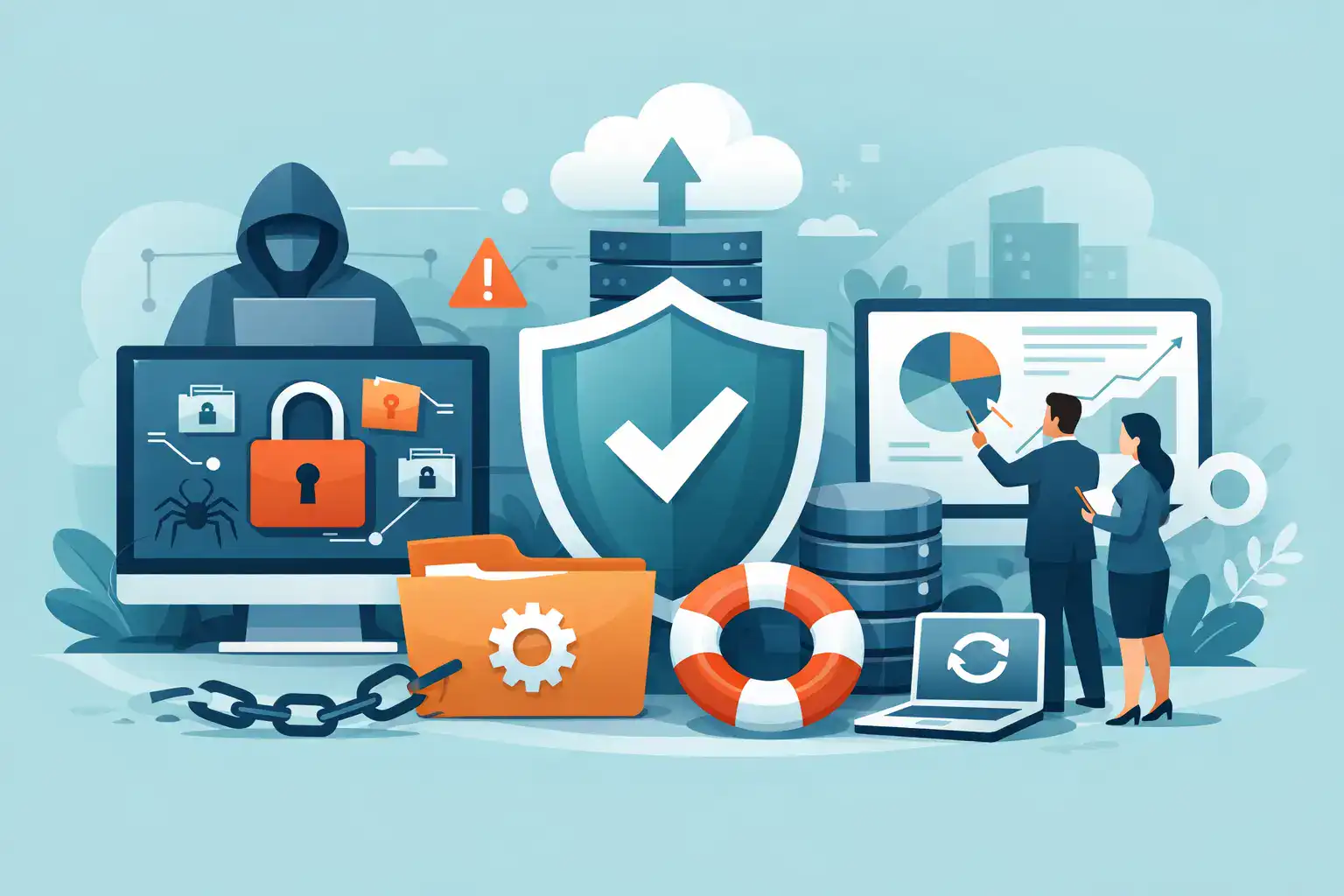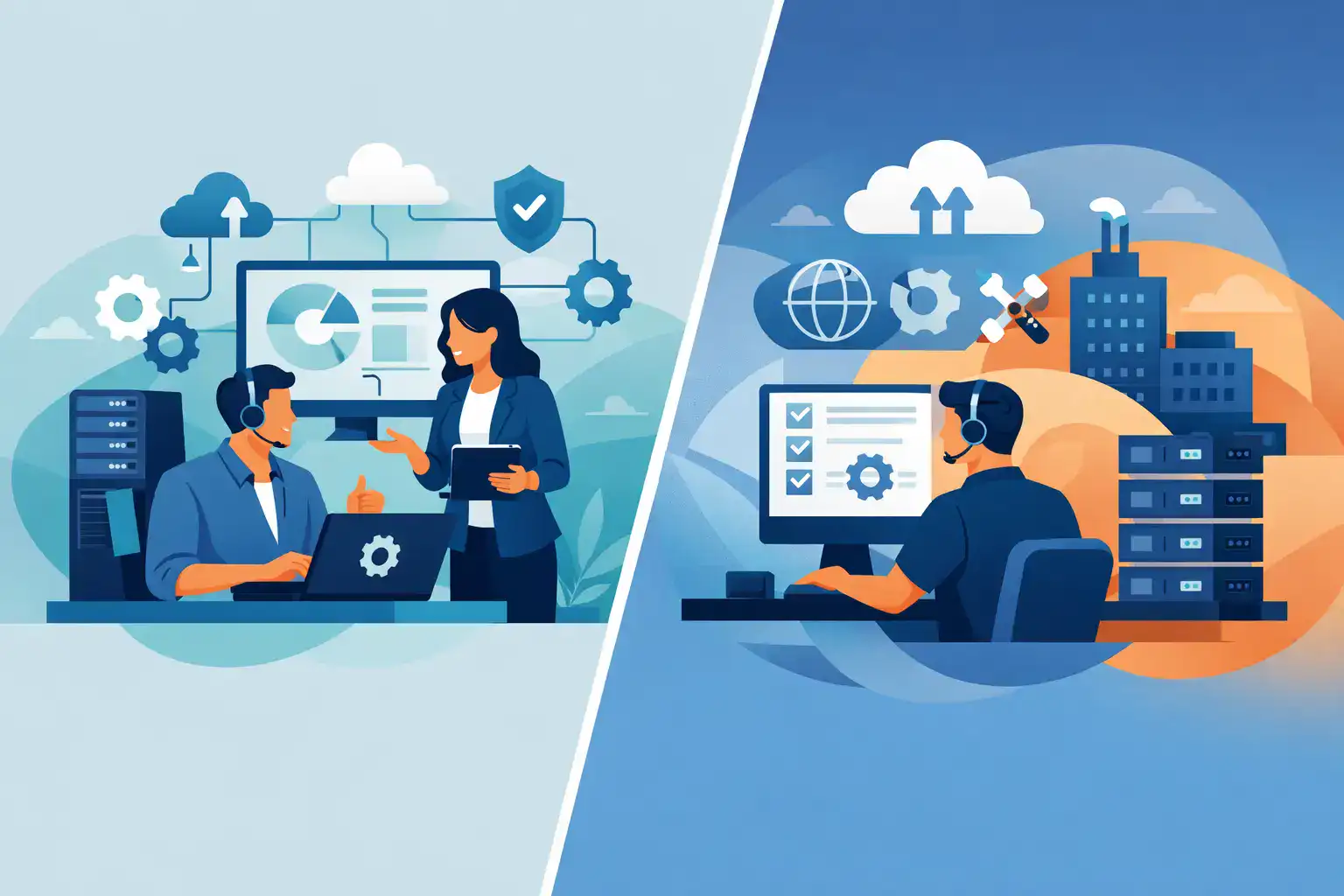

When your team is waiting on password resets, printers keep dropping offline, and security alerts are landing in someone’s already full inbox, the question stops being whether you need support. It becomes whether co-managed IT vs outsourced IT is the better fit for how your business actually runs.
For many SMEs, that choice is less about theory and more about pressure. You may already have an internal IT person who is stretched across support, suppliers, security, onboarding and procurement. Or you may have no in-house capability at all and need a provider to take full responsibility. Both models can work well, but they solve different problems and come with different expectations around control, cost and accountability.
What co-managed IT vs outsourced IT really means
Co-managed IT is a shared support model. Your internal team keeps ownership of some areas, while an external provider fills the gaps. That could mean extra helpdesk capacity, specialist cybersecurity support, cover for annual leave, help with cloud projects, or monitoring and patching that your team does not have time to manage properly.
Outsourced IT is a fully managed arrangement. Instead of sharing responsibility with an internal department, the provider becomes your primary IT function. They handle the day-to-day support, maintenance, security oversight, supplier coordination and strategic guidance, based on the scope agreed.
The difference matters because it shapes how quickly issues are handled, who makes decisions, and where business risk sits. A co-managed arrangement strengthens internal capability. An outsourced arrangement replaces the need to build and maintain a broad internal IT function.
When co-managed IT makes sense
Co-managed IT tends to suit businesses that already have someone in-house but need stronger coverage. That might be a growing company with a single IT manager, or an operations lead who has inherited technology responsibility without the time or specialist knowledge to cover everything well.
In that setup, external support can remove pressure from the internal team rather than displace it. Your staff still retain visibility and influence, but they are not left handling every support ticket, cyber risk review, licence issue and infrastructure problem on their own.
This model is often a good fit when your business wants to keep internal ownership of certain systems or decisions. For example, your in-house team may want to lead on user policies, key line-of-business applications or long-term planning, while a provider manages helpdesk overflow, Microsoft 365 administration, backup checks or endpoint security.
It also works well where specialist knowledge is missing. Many SMEs do not need a full-time cybersecurity engineer, cloud architect and telecoms specialist on payroll. Co-managed IT gives you access to those skills without hiring for each one.
That said, co-managed IT is not automatically the more flexible or cheaper option. It only works well when responsibilities are clearly split. If both sides assume the other is handling patching, backup testing or supplier escalations, gaps appear quickly.
The strengths of co-managed IT
The main advantage is balance. You keep internal familiarity with the business while adding wider technical depth and more reliable coverage. It can also be less disruptive than moving fully to an outsourced model because your existing team remains central.
For growing businesses, co-managed support can also be a sensible stepping stone. It lets you improve resilience now without making an immediate structural change to how IT is managed.
The trade-offs
Shared responsibility needs strong communication. If your internal team is disorganised, overprotective of systems, or unclear about priorities, the provider may struggle to deliver the full value of the partnership. Co-managed IT also depends on having someone in-house who can still engage, make decisions and coordinate where needed.
When outsourced IT is the better option
Outsourced IT is usually the stronger choice when you want one provider to take ownership of the whole environment. That is often the case for SMEs without an internal IT department, or for businesses that have outgrown ad hoc support and need a more dependable service model.
If technology issues are distracting your office manager, finance lead or business owner, full outsourcing can bring immediate relief. Instead of relying on whoever is available to chase suppliers or troubleshoot user issues, you have a defined support structure with processes, escalation paths and broader coverage.
It is also a good option when business continuity and security need more discipline than an informal arrangement can provide. Backup monitoring, patch management, access control, device standards and incident response tend to improve when there is a single accountable partner managing them as part of an ongoing service.
For many SMEs, outsourced IT is less about handing everything away and more about gaining consistency. Good providers do not remove visibility. They provide reporting, recommendations and guidance while taking the operational burden off your team.
The strengths of outsourced IT
The biggest benefit is clarity. One provider is responsible for support, maintenance and service performance within the agreed scope. That reduces the finger-pointing that can happen when multiple suppliers and internal stakeholders are involved.
Outsourcing can also be more cost-effective than building a small in-house team, especially once you factor in recruitment, training, annual leave cover and access to specialist skills. For businesses that need reliable support but cannot justify a full internal department, this model is often the most practical.
The trade-offs
You are placing more trust in an external partner, so provider quality matters a great deal. If the service is reactive, slow or poorly documented, your business feels the impact quickly. There can also be an adjustment period if your staff are used to walking over to a colleague’s desk for help rather than logging issues through a service desk.
Co-managed IT vs outsourced IT on cost, control and risk
Cost is usually one of the first questions, but it should not be looked at in isolation. A lower monthly fee means very little if outages last longer, security controls are weak, or your internal team is firefighting all week.
Co-managed IT can look cost-efficient if you already have capable internal staff and only need support in selected areas. In that case, you are paying to strengthen existing capability rather than duplicate it. But if your in-house resource is too limited to manage their side of the arrangement properly, the hidden cost is delay and inconsistency.
Outsourced IT often gives clearer budgeting because the service scope is broader and more predictable. It can also reduce the cost of downtime by improving response times, patching discipline and preventative maintenance. For many SMEs, that operational stability is where the real return sits.
Control is another common concern. Some businesses assume outsourced IT means losing influence, while co-managed IT means keeping all control. In practice, it depends on how the relationship is structured. A well-run outsourced model should still give you clear approval points, reporting and strategic input. A badly run co-managed model can leave you with nominal control but poor visibility.
On risk, the key question is simple: who is actively watching the important things? If security alerts, failed backups, ageing hardware and user access changes are not being monitored consistently, your business is exposed regardless of the support model on paper.
How to decide which model fits your business
Start with an honest view of your current setup. If you have a capable internal IT lead who understands the business and just needs more capacity or specialist backup, co-managed IT may be the right move. If you are relying on non-technical staff, piecemeal suppliers or break-fix support, outsourced IT is likely to give you a stronger foundation.
Then look at complexity. The more moving parts you have – cloud platforms, remote users, compliance requirements, cybersecurity concerns, telephony, office moves or ageing infrastructure – the more important it is to have clear ownership and dependable support.
You should also think about resilience. What happens when your internal IT person is off sick, leaves the business, or gets tied up in a project? If too much knowledge sits with one individual, co-managed support can reduce that risk. If there is no real internal capability at all, outsourcing may be the more responsible option.
For Dublin SMEs in particular, responsiveness and local support can still matter, especially where office infrastructure, connectivity and on-site troubleshooting are part of the picture. A provider that can support both day-to-day operations and wider business continuity planning is often more valuable than one focused only on tickets.
Choosing the right partner matters as much as the model
The co-managed IT vs outsourced IT decision is important, but the service quality behind it matters just as much. A good partner should be clear about responsibilities, responsive when issues arise, and capable across support, security, cloud and recovery planning. They should also understand that for SMEs, IT is not an isolated department. It affects productivity, customer service and the ability to keep trading when something goes wrong.
If you are choosing between the two, do not ask only which model sounds better. Ask which one gives your business the support structure it needs to reduce downtime, stay protected and keep people working without unnecessary disruption. The right answer is the one that leaves fewer gaps, not the one that sounds more impressive.