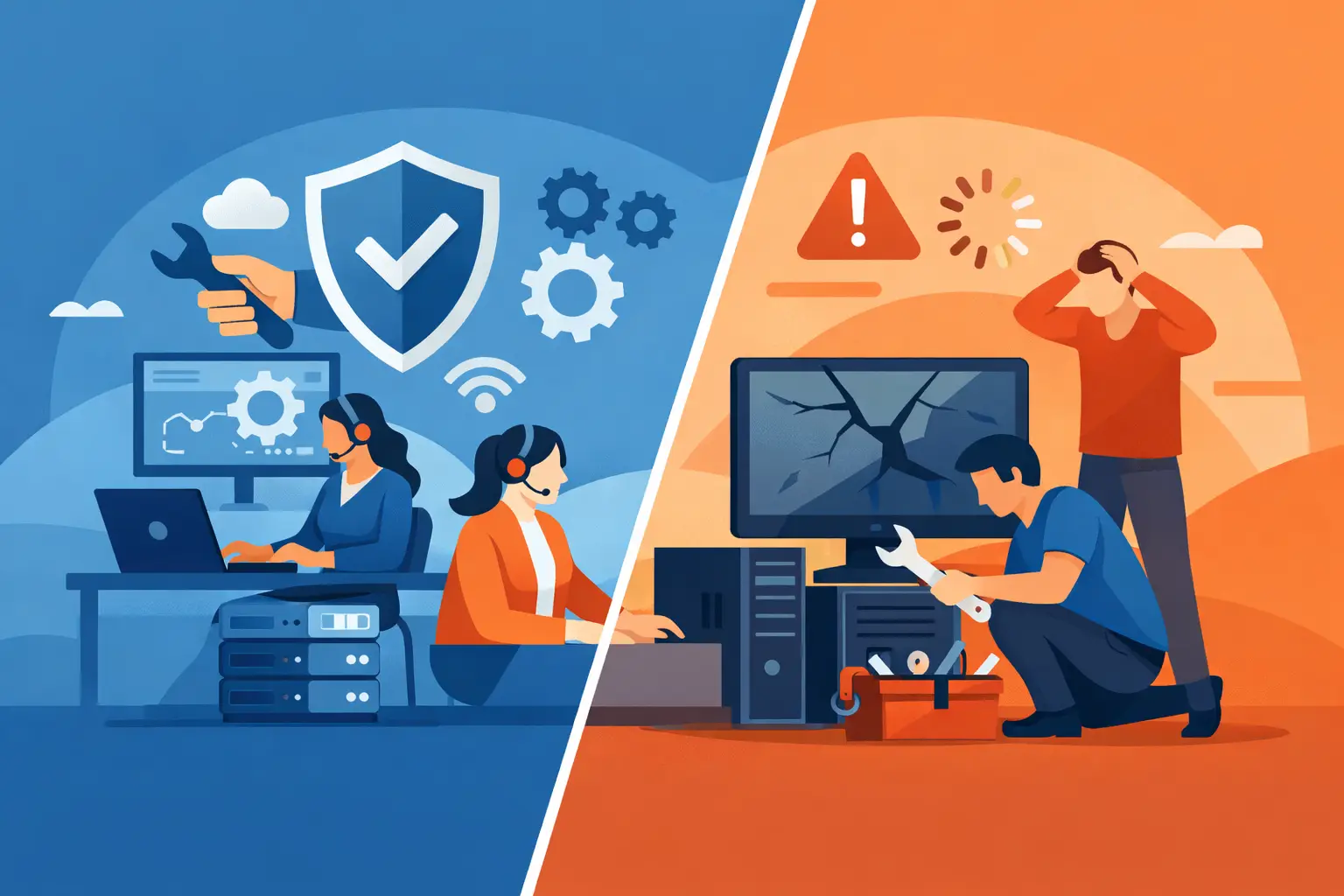

When a member of staff cannot access files, emails stop syncing, or a cyber alert lands at 8.15 on a Monday morning, the value of outsourced IT support benefits becomes very real. For most SMEs, technology is not a side issue. It affects sales, customer service, cash flow, compliance, and the ability to keep the business moving without interruption.
For smaller organisations in particular, the question is rarely whether IT support is needed. It is whether building everything in-house makes financial and operational sense. In many cases, it does not. Outsourcing gives businesses access to broader expertise, tighter processes, and more predictable support without the cost and complexity of maintaining a large internal team.
Why outsourced IT support benefits matter
The main reason businesses look outside their own walls is simple. They need dependable support, but they do not need a full bench of specialists sitting in the office every day. A growing company may need helpdesk support, cyber security oversight, backup checks, Microsoft 365 administration, network troubleshooting, and advice on hardware lifecycle planning. Hiring all of that internally is expensive and often unrealistic.
Outsourced support changes the model. Instead of relying on one over-stretched generalist or asking non-technical staff to patch things together, the business gets access to a service team with defined processes and wider technical coverage. That can reduce delays, improve resilience, and remove single points of failure.
That does not mean outsourcing is automatically better in every case. Larger organisations with complex internal systems may still need an in-house IT function. But for many SMEs, outsourced support provides the right balance of capability, responsiveness, and cost control.
Lower costs without cutting corners
The most obvious of the outsourced IT support benefits is cost. Recruiting experienced IT staff is expensive, and the salary is only part of the picture. There is pension, training, holiday cover, recruitment time, software tooling, and the management overhead that comes with running an internal function.
Outsourcing usually turns that into a clearer monthly operating cost. That makes budgeting easier and reduces the risk of unexpected spend every time a technical issue appears. It also helps avoid under-hiring. Many SMEs appoint one person and expect them to cover support, security, infrastructure, cloud, procurement, and strategy. That is a wide brief for any individual.
A managed support arrangement gives access to a team rather than a single employee. In practical terms, that often means better coverage for less than the cost of building the same capability in-house.
Faster response when issues affect the working day
Downtime is expensive even when the problem looks minor. If staff cannot log in, the phones are down, remote access fails, or a shared printer blocks document handling at a key moment, productivity drops quickly. Small interruptions can have a disproportionate impact on smaller businesses because there is less slack in the system.
One of the strongest outsourced IT support benefits is speed of response. A service-led provider typically has ticketing, monitoring, escalation paths, and engineers with different specialisms. Problems are identified, prioritised, and resolved through a consistent process.
That matters because business owners and office managers should not be chasing suppliers, searching forums, or asking the most technical person in the office to stop their actual job and investigate. Good support protects time as much as it fixes faults.
Access to broader expertise
IT is no longer one discipline. A business might need advice on cyber security, connectivity, cloud migration, backup policy, user permissions, telecoms, device rollout, and disaster recovery, sometimes in the same quarter. Expecting one in-house person to stay current across every area is difficult.
Outsourcing gives access to a wider range of knowledge. That breadth is especially useful when issues overlap. A login problem may not be just a password issue. It could involve identity management, network configuration, endpoint security, or third-party application access. A good external team sees these dependencies more quickly.
For SMEs, this has a practical advantage. Instead of managing several vendors for different parts of the technology estate, they can work with one partner who understands how the pieces fit together. That tends to reduce finger-pointing and shorten the path to a fix.
Better security and less reactive firefighting
Cyber security has become a board-level concern for businesses of every size. The risk is not limited to large enterprises. SMEs are often targeted because they may have fewer controls in place, older devices, weaker password discipline, or limited monitoring.
Another of the key outsourced IT support benefits is more consistent security oversight. This can include patch management, endpoint protection, access control, backup validation, user guidance, and a clearer response plan if something goes wrong. Security works best when it is part of day-to-day operations rather than an occasional project.
There is an important caveat here. Outsourcing does not remove responsibility. The business still needs sensible policies, staff awareness, and leadership buy-in. But an experienced provider can put structure around security so it does not depend on someone remembering to deal with it when they have time.
Stronger business continuity
Most companies do not think seriously about continuity until they have an outage, a failed server, accidental deletion, or a ransomware incident. At that point, the quality of backup and recovery arrangements becomes painfully clear.
A reliable support partner will not only help maintain systems, but also look at what happens if those systems fail. That includes recovery planning, backup testing, access to replacement infrastructure, and practical guidance during disruption. The aim is not just to restore technology. It is to keep the business trading.
This is where outsourcing often delivers more value than expected. Continuity is not a single product. It is an operational discipline. SMEs usually benefit from having that discipline built into ongoing support rather than treated as a one-off exercise.
Easier growth and change
Business growth creates pressure on IT. New starters need devices and accounts. Additional sites need connectivity. Cloud services need governance. Phone systems may need to scale. Office relocations require planning so staff can remain productive with minimal disruption.
One of the more practical outsourced IT support benefits is flexibility. Support can expand with the business without requiring a full restructure or several new hires. That is useful not only during growth, but also during periods of change such as acquisitions, relocation, hybrid working adjustments, or software rollouts.
A provider with experience across infrastructure, communications, cloud, and security can make those changes more controlled. That reduces the chance of fragmented systems building up over time, which is often what creates avoidable support issues later.
Clearer accountability and service levels
Internal support can become informal. Staff tap someone on the shoulder, issues are handled in the order people shout about them, and recurring problems are never properly addressed. That may feel convenient, but it rarely scales well.
With outsourced support, accountability is usually more defined. There are service levels, documented tickets, escalation routes, and reporting. That gives decision-makers better visibility into recurring faults, response performance, asset age, and security gaps.
This structure matters because it turns IT support from a reactive necessity into a managed service with measurable outcomes. For busy SME leaders, that visibility helps when planning investment and setting priorities.
When outsourcing is the right fit
Outsourcing tends to work well for businesses that want reliable day-to-day support, stronger protection, and access to wider expertise without carrying the cost of a large in-house team. It is particularly effective where operations depend heavily on systems staying available, but internal technical resources are limited.
It may be less suitable if the organisation has highly bespoke internal platforms that require permanent on-site technical ownership. Even then, a hybrid model can work. Some businesses keep strategic or application-specific roles in-house while outsourcing support, infrastructure management, or security operations.
The right approach depends on how critical technology is to your operation, how much internal capability you already have, and where the current risks sit. If downtime is recurring, security feels patchy, or your team spends too much time chasing technical issues instead of running the business, those are signs the current model may be under strain.
Choosing a partner, not just a supplier
The difference between helpful outsourcing and frustrating outsourcing usually comes down to service quality. A good provider learns how your business works, responds quickly, communicates clearly, and focuses on operational outcomes rather than technical jargon.
That is especially important for SMEs, where technology decisions are often made by people with broad responsibilities. Business owners, operations managers, and office leads need support that is accessible and decisive. They need issues resolved, risks explained plainly, and recommendations that match the pace and budget of the business.
For that reason, the best outsourced relationships feel less like buying ad hoc technical help and more like gaining an extension of your team. That is the model many Irish SMEs look for from providers such as Host-It, where support, continuity, communications, cloud, and security are treated as connected parts of business resilience.
Technology should help your business move faster, serve customers better, and recover quickly when something goes wrong. If your current setup does the opposite, outsourced support is not just a cost decision. It is a practical way to reduce friction, protect operations, and give your team room to focus on the work that matters.
To see how these benefits apply to an Irish business, read about our managed IT service.