
When your phones are dropping calls, cloud files are crawling and card payments stall at the till, the question of leased line versus business broadband stops being technical and becomes operational. For most SMEs, connectivity is now as critical as power, because if your internet fails, staff productivity, customer service and security controls can quickly follow.
The right choice depends less on headline speed and more on how your business works day to day. A five-person office using email and cloud accounting has very different needs from a busy team running VoIP, large backups, remote access, CCTV and multiple SaaS platforms at the same time. That is why comparing these services properly means looking at reliability, performance under pressure, support and business risk – not just monthly cost.
Leased line versus business broadband – what is the difference?
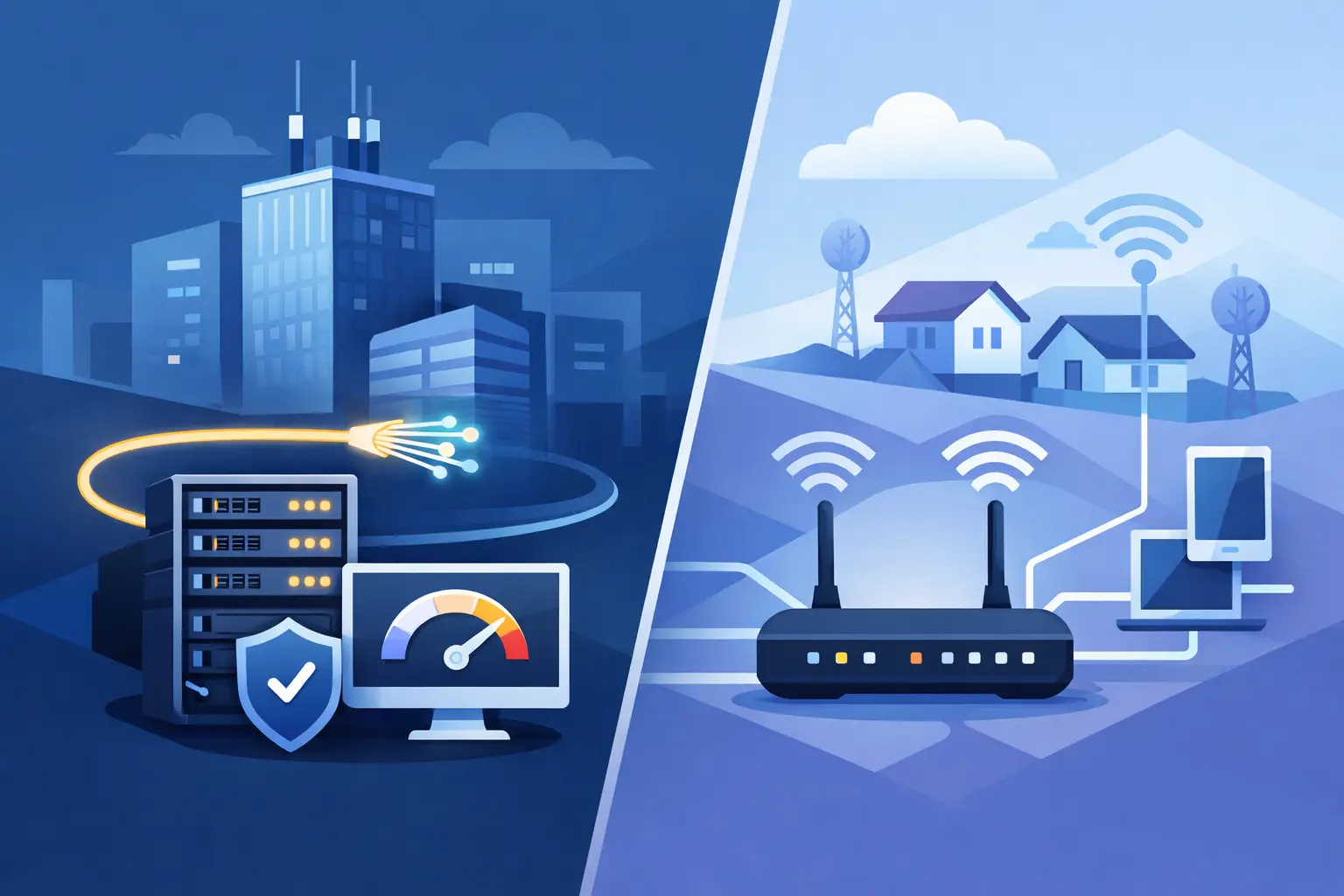
A business broadband connection is usually a shared service. Your business accesses internet capacity along with other nearby users, which means performance can vary depending on demand, local network conditions and the type of line available at your premises. In many cases, that is perfectly workable, especially for smaller offices with modest usage.
A leased line is different. It is a dedicated connection delivered specifically to your business. Because the bandwidth is not shared in the same way, speeds are more consistent and service levels are usually much stronger. That matters when your team relies on cloud systems all day and downtime has a real cost.
The practical distinction is consistency. Business broadband may advertise fast download speeds, but actual performance can fluctuate. A leased line is designed for predictability, which is often what businesses need most.
Why speed figures can be misleading
Many decision-makers start with Mbps or Gbps, which is understandable, but speed alone rarely tells the full story. Business broadband often offers higher download than upload speeds. That can be fine for general browsing, but modern businesses upload constantly – video meetings, cloud backups, Microsoft 365 files, CRM data, security monitoring and off-site storage all depend on strong upstream performance.
Leased lines usually provide symmetrical speeds, so upload and download are the same. If your team is sending as much as it receives, that balance can make a noticeable difference. Video calls stay stable, shared files sync faster and backup windows become more manageable.
Latency also matters. If you use hosted phones, remote desktops or cloud applications, lower and more stable latency supports a better user experience. A connection that looks adequate on paper can still feel slow in practice if responsiveness is poor.
Reliability is often the real deciding factor
For many SMEs, reliability is the main reason to consider a leased line. Broadband can be dependable, but it is still more vulnerable to congestion and variable performance. If your office can tolerate the occasional slowdown or short outage, the lower cost may justify that trade-off.
If it cannot, the calculation changes. A law firm unable to access case files, a warehouse losing barcode scanning, or a customer service team cut off from VoIP is not dealing with a minor inconvenience. It is lost time, frustrated staff and potential damage to customer relationships.
Leased line services usually come with stronger service level agreements, including target fix times. That does not mean faults never happen, but it does mean the supplier is contractually committed to a faster, more business-focused response. For organisations where connectivity supports revenue, that assurance has value.
Cost versus risk
Business broadband is cheaper, often substantially so. For smaller firms, that can make it the sensible choice. If your team is light on bandwidth, your systems are not heavily cloud-dependent and you have workable fallbacks in place, broadband may be entirely appropriate.
A leased line costs more because you are paying for dedicated capacity and higher-grade support. The mistake some businesses make is comparing only the monthly bill without pricing the impact of outages, delays and lost productivity. If twenty staff cannot work properly for half a day, the savings can disappear quickly.
This is where a risk-based view helps. Ask what one hour of downtime actually costs your business. Include wages, missed sales, delayed service, reputational damage and the knock-on effect on deadlines. Once you frame connectivity as a continuity issue rather than a utility bill, the right decision often becomes clearer.
When business broadband is the right fit
Business broadband remains a good option for plenty of SMEs. If your company has a small team, moderate cloud usage and no major dependency on real-time systems, it can deliver good value. It also suits businesses opening new premises quickly where lead time and installation costs matter.
It can work well for firms that have resilience built in elsewhere. For example, if key staff can tether to mobile data temporarily, or if a second connection is already available as backup, the risk of relying on broadband may be acceptable.
There is also a middle ground. Some businesses do not need a leased line at every site. A smaller branch office, short-term workspace or low-demand location may be well served by business broadband, while the main office or core operational site uses a dedicated circuit.
When a leased line makes more sense
A leased line is usually the stronger option when internet access is central to daily operations. That includes businesses using VoIP throughout the day, running cloud-based systems across multiple departments, transferring large files, supporting remote workers through VPNs or relying on off-site backup and disaster recovery.
It also makes sense where downtime is especially disruptive. Professional services, logistics, healthcare settings, customer support teams and multi-user offices often benefit from the stability and faster fault response a leased line provides.
Security is part of the picture too. While a leased line does not replace firewalls, monitoring or good cyber hygiene, it can support a more controlled and predictable environment for business-critical traffic. When paired with managed networking and continuity planning, it becomes part of a wider resilience strategy rather than a standalone product.
Leased line versus business broadband for growing firms
Growth changes connectivity needs quickly. A connection that felt fine with eight staff can become a bottleneck with twenty, especially if you have moved to cloud telephony, adopted more SaaS tools or increased remote collaboration.
That is why it is worth planning ahead. If you expect headcount to rise, if you are moving premises, or if you are shifting more services into the cloud, choosing the cheapest short-term connection can create a second project sooner than you would like. It is often more efficient to align your internet service with where the business will be in twelve to twenty-four months, not just where it is today.
For Dublin businesses in particular, office moves, hybrid working and hosted telephony have changed the pressure on internet connections. What used to be a basic line for email and web access is now expected to carry voice, collaboration, file sharing, backup traffic and security services at the same time.
Questions worth asking before you decide
The best buying decisions usually come from a short operational review. How many people rely on the connection at peak times? Which systems stop if the internet goes down? Are uploads as important as downloads? How long can you realistically tolerate an outage? Do you need guaranteed fix times? And if the connection fails, what is your fallback?
You should also look at installation lead times. Business broadband is often faster to provision, while leased lines can take longer depending on site surveys and local infrastructure. That does not make broadband better – it simply means timing needs to be part of the plan.
Support matters as well. If your connectivity sits alongside managed IT, security, cloud services and VoIP, there is a clear advantage in having joined-up accountability. Problems get resolved faster when one provider understands the whole environment instead of only the circuit.
The better question is not which is best
Leased line versus business broadband is not really a question of which service wins overall. It is a question of which one matches your operational risk, usage profile and growth plans. Broadband is cost-effective and often sufficient. A leased line offers greater certainty and stronger protection against disruption. Both have a place.
If your business runs happily on broadband today, that is fine. If your team is increasingly cloud-reliant, customer-facing and sensitive to downtime, it may be time to treat connectivity as part of your business continuity plan rather than a simple monthly utility. The right connection is the one that keeps your people productive, your systems available and your business moving when the pressure is on.