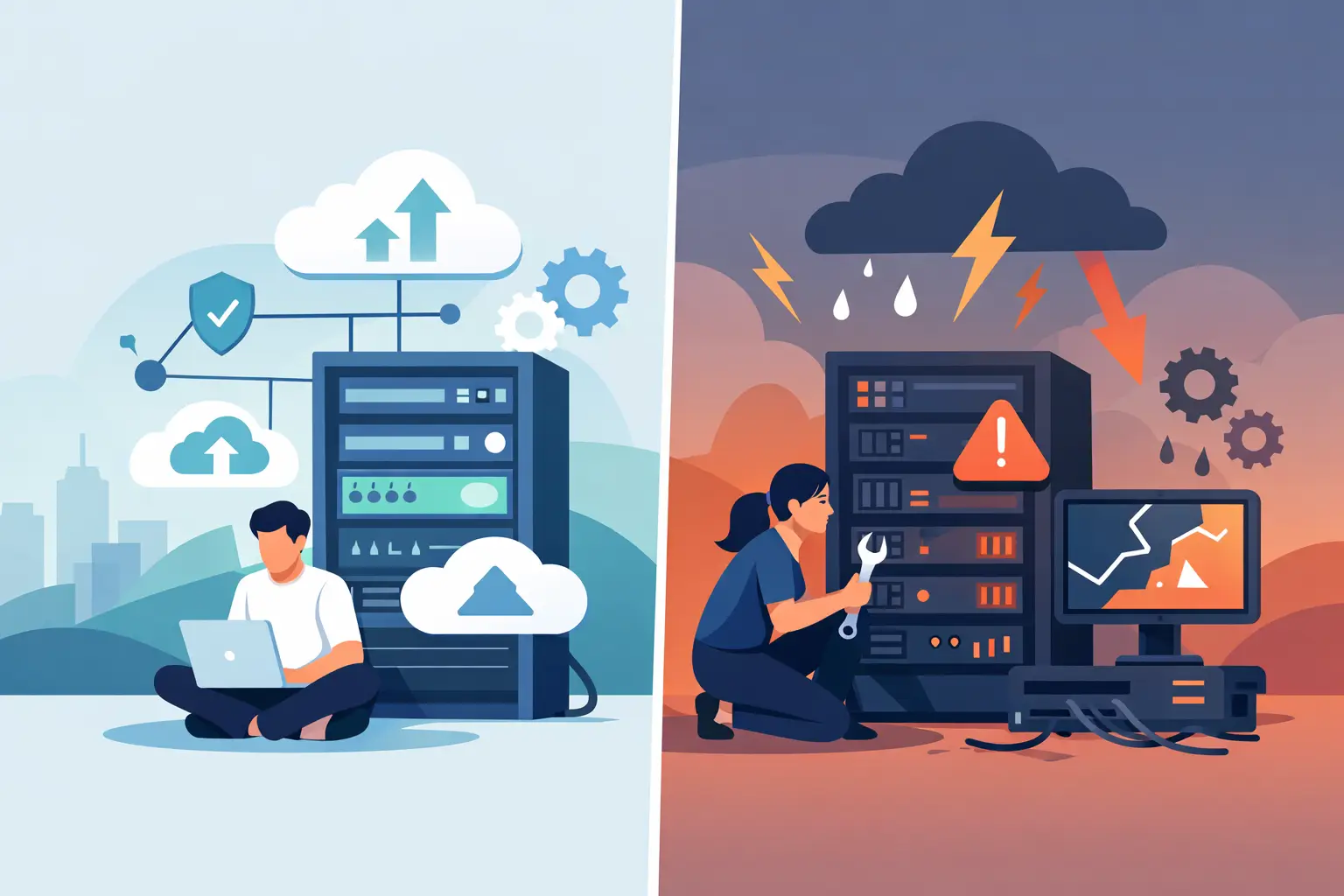

When a member of staff cannot log in, your phones drop out during a busy morning, or a backup fails when you need it most, the debate around managed support versus internal IT stops being theoretical. It becomes a business decision with direct consequences for productivity, customer service and risk. For many SMEs, the real question is not which model sounds better on paper, but which one will keep the business running reliably day after day.
What managed support versus internal IT really means
Internal IT usually means employing one or more people to manage your systems, users, devices and suppliers in-house. They may look after everything from onboarding staff and fixing laptops to cyber security, Microsoft 365 administration, network issues and vendor management. In some businesses, that team is a single over-stretched IT manager. In others, it is a small department with broader coverage.
Managed support means outsourcing some or all of that responsibility to a specialist provider under an ongoing service arrangement. Instead of relying on one employee or a small internal team to cover every issue, you gain access to a wider bench of expertise across support, infrastructure, cloud, communications, backup and security. The service is designed to prevent problems, respond quickly when incidents happen and provide continuity as your needs change.
That distinction matters because most SMEs do not simply need someone to fix computers. They need stable systems, secure access, dependable backup, support for hybrid working, advice on upgrades, and a plan for when something goes wrong.
Cost is rarely as simple as salary versus contract
On the surface, internal IT can look more straightforward. You hire someone, pay a salary and bring the function in-house. For businesses that prefer direct control, that can feel like the safer option.
The challenge is that salary is only one part of the cost. Recruitment, pension, training, holiday cover, sick leave, tools, certifications and turnover all add up. If your internal resource leaves, your business may lose not only capacity but also critical knowledge. Replacing them can take months.
Managed support usually shifts IT into a more predictable operating cost. That appeals to SMEs because budgeting becomes easier and support does not disappear when one person is unavailable. It also removes the pressure of trying to recruit specialist skills for every area of IT.
That said, managed support is not automatically cheaper in every case. If you are a larger business with complex internal systems and enough scale to justify a full team, an in-house model may make financial sense. The right comparison is not just monthly spend. It is what you receive for that spend, how much risk is reduced, and how much downtime is avoided.
Coverage and resilience are often the deciding factor
This is where managed support versus internal IT becomes clearer for many SMEs. Internal teams, especially small ones, can be excellent at understanding the business but limited by time and specialist knowledge. One person cannot be an expert in cyber security, cloud migrations, telephony, disaster recovery, compliance, networking and user support all at once.
A managed provider gives you broader coverage by design. You are not relying on a single individual to carry every responsibility. If a cyber security issue emerges, there is specialist input available. If your office move affects connectivity and phones, the same relationship can support the wider project. If backups need reviewing, that sits within the same service picture rather than becoming a separate problem for another supplier.
For businesses where continuity matters, resilience counts more than familiarity alone. IT support should not depend on whether one key employee is on leave or tied up with another issue.
Security changes the equation
Many SMEs still think of IT support as helpdesk work, device setup and occasional troubleshooting. The reality is broader. Every business now has to consider phishing, ransomware, access control, patching, email security, backup integrity and recovery planning.
An internal IT resource may handle these responsibilities well, but only if they have the time, tools and experience to do so properly. In smaller firms, security can become reactive. Password resets and printer issues take priority, while wider risk management gets pushed down the list.
Managed support can strengthen security because it is built around process, monitoring and repeatable controls. That does not mean every provider delivers the same standard, and it does not remove your own responsibility as a business. It does mean the service model is often better suited to consistent protection, especially when cyber security is integrated with day-to-day support rather than treated as an occasional add-on.
For SME leaders, that matters because the cost of a serious incident is not just technical. It affects operations, customer trust and revenue.
Internal IT offers closeness, but that can cut both ways
There are real advantages to having IT in-house. An internal person or team knows your staff, your systems and the quirks of your business. They can build strong working relationships and often understand operational priorities quickly. In businesses with highly specialised systems or unusual workflows, that knowledge is valuable.
But closeness can also create dependency. If too much knowledge sits with one individual, the business becomes vulnerable. Documentation is often incomplete. Processes evolve informally. Decisions get made based on habit rather than long-term planning.
A good managed support relationship should still feel close and accountable, but with more structure behind it. The aim is not to feel distant or generic. It is to give your business dependable support with documented processes, wider expertise and clearer continuity.
Managed support versus internal IT for growing SMEs
Growth is where the limitations of a purely internal model often show up first. Opening a new site, rolling out new devices, moving to the cloud, improving remote access or replacing ageing infrastructure can overwhelm a small in-house team. The result is delay, patchwork decisions or the need to bring in outside contractors anyway.
Managed support is often better aligned with change because scale is built into the service. As your business adds users, locations or new systems, you can expand support without having to redesign the entire IT function around each stage of growth.
That does not mean internal IT has no place in a growing business. Some SMEs benefit from having a capable internal coordinator who understands the business and works alongside a managed provider for specialist support, projects and security. In practice, this hybrid model is often the most effective. It combines internal visibility with external depth.
The right model depends on business risk, not just preference
When comparing managed support versus internal IT, it helps to move beyond simple preference. Ask what happens if your core systems fail for a day. Ask who owns security monitoring, backup testing, supplier coordination and disaster recovery. Ask whether your current setup could support an office move, a cloud migration or a serious cyber incident without major disruption.
If your business has modest day-to-day needs, stable systems and genuine in-house expertise with proper cover, internal IT may work well. If you need wider support across infrastructure, communications, cloud and protection without building a full department, managed support is often the more practical fit.
Most SMEs are not trying to become technology companies. They are trying to keep people productive, protect data and avoid disruption. That is why service reliability, response times and continuity planning matter so much more than the old idea of having someone nearby to reboot a machine.
What to look for if you choose managed support
Not all providers are the same, so the decision should be based on service depth rather than price alone. You need clear scope, responsive support, security capability, documented processes and enough breadth to support your wider estate. If telephony, cloud, backups and connectivity all sit with different suppliers, issues can take longer to resolve because nobody owns the whole picture.
That is where an integrated service model becomes valuable. A provider such as Host-It can support SMEs more effectively because support, continuity and protection are considered together rather than as isolated services. For businesses that want one accountable partner instead of a chain of separate vendors, that can reduce delay and simplify decision-making.
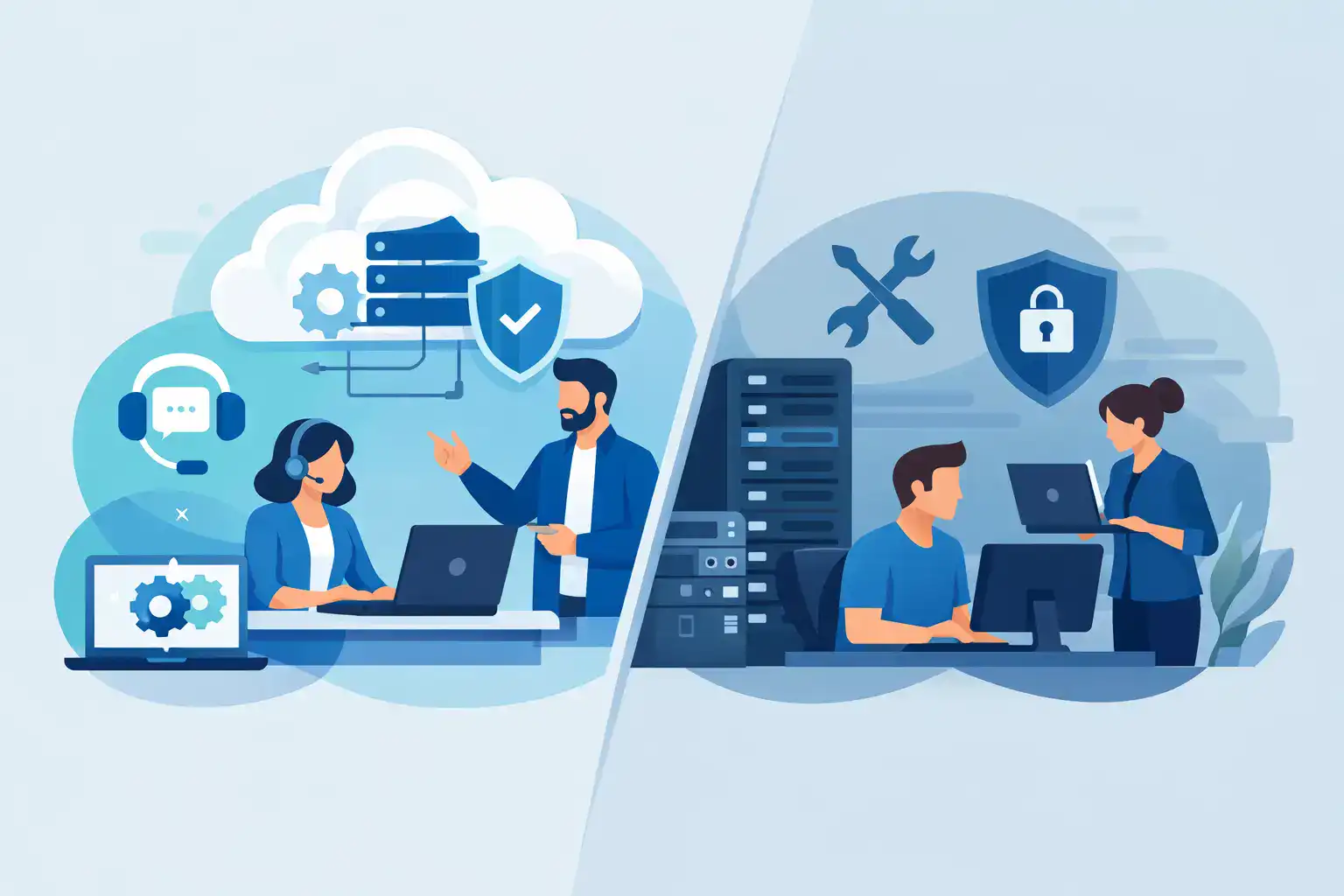
There is no single answer that suits every organisation. Internal IT can be the right choice where scale, complexity and internal capability justify it. Managed support can be the right choice where resilience, access to broader expertise and predictable service matter most. For many SMEs, the strongest option sits somewhere in between.
The useful test is simple: choose the model that gives your business dependable cover on an ordinary Tuesday, not just during a major project or emergency. That is usually the clearest sign your IT is supporting the business properly.