
When a customer rings, the decision between VoIP versus PBX is not really about handsets or technical jargon. It is about whether your team can answer reliably, transfer calls quickly, work from another location when necessary and keep communicating when an incident affects the office. For SMEs, the right phone system should reduce friction for staff while supporting business continuity.
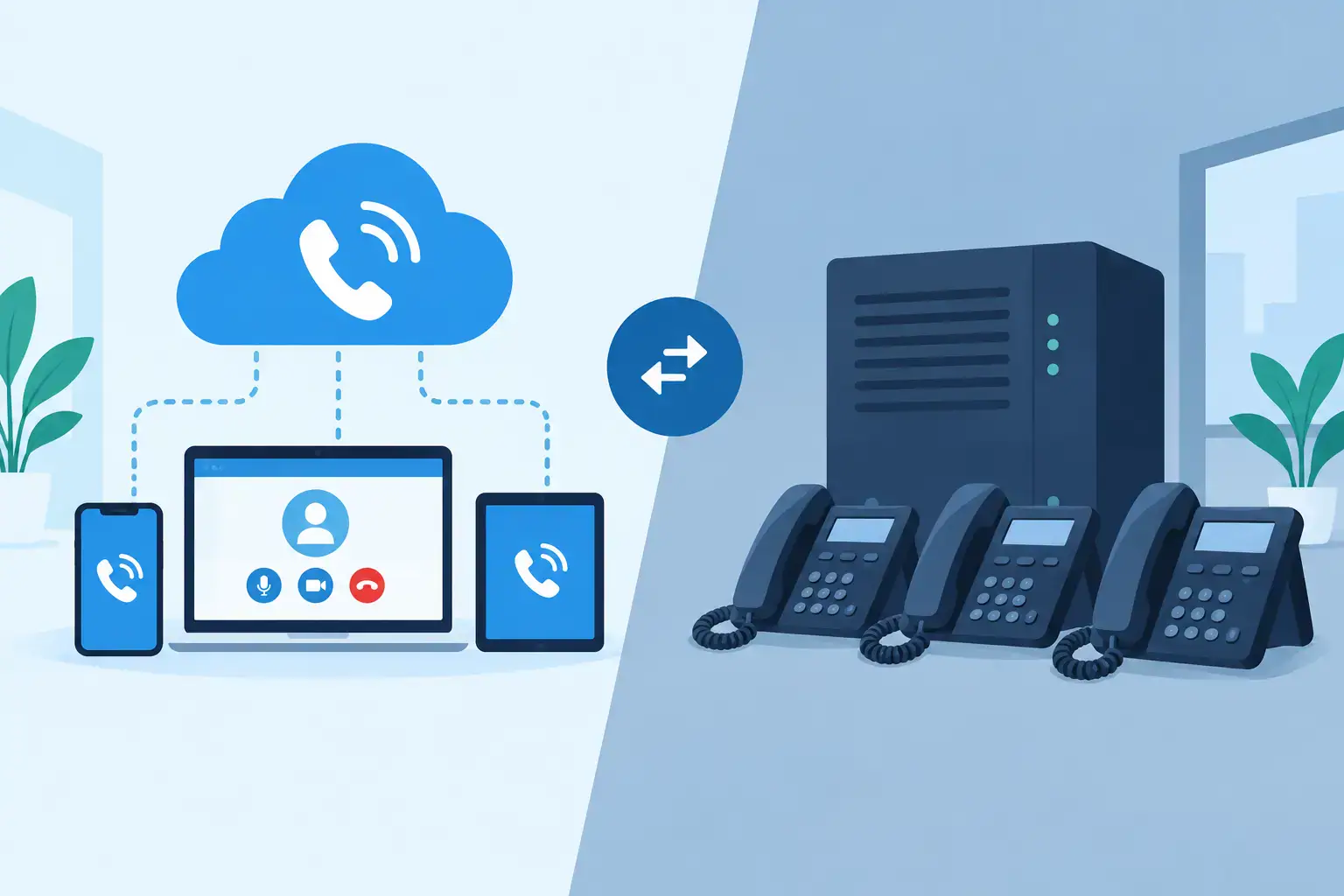
The terms are often treated as opposites, but the choice is more nuanced. A modern phone system can use VoIP technology and still operate as a PBX. The practical question is whether you need an on-site system, a cloud-hosted service or a hybrid arrangement that fits your operations, connectivity and risk profile.
VoIP versus PBX: the core difference
A traditional PBX, or private branch exchange, is the equipment that manages internal extensions and routes calls to and from external telephone lines. Historically, it sat in a comms cupboard and connected to physical phone lines. It gave businesses control over call routing, voicemail, hunt groups and internal calling, but it also created a dependency on specialist hardware, maintenance and fixed office infrastructure.
VoIP, short for Voice over Internet Protocol, carries calls across an internet connection rather than conventional phone lines. A VoIP service may be delivered through desk phones, a mobile application or a computer headset. It can also sit behind a cloud PBX, where the call-control platform is hosted in a secure data centre rather than in your premises.
That distinction matters. Comparing VoIP with PBX as if they are entirely separate products can lead to the wrong decision. In many cases, a cloud PBX is a VoIP system. The real comparison is usually between a legacy on-premises PBX and a hosted VoIP phone platform.
Where hosted VoIP gives SMEs an advantage
For businesses with hybrid staff, multiple sites or plans to grow, hosted VoIP is usually the more flexible option. Users can retain their business number while taking calls from a desk phone, laptop or mobile app. Reception teams can see presence information, transfer calls to colleagues working remotely and maintain a professional experience without relying on personal mobile numbers.
The commercial model is also easier to plan. Instead of a large upfront investment in a PBX server and associated telephony hardware, hosted services commonly use a predictable per-user monthly cost. Adding a new starter, temporary extension or additional location is normally straightforward, provided the network has enough capacity.
VoIP also makes continuity planning more practical. If an office is inaccessible due to a power issue, building problem or local connectivity fault, calls can be diverted to mobiles or an alternative location. That does not remove every risk, but it avoids making your main business number dependent on one building.
Features that once felt reserved for larger organisations are often included or readily available: auto-attendants, call queues, voicemail to email, call reporting, recorded messages and flexible opening-hours rules. The value is not in having every feature switched on. It is in configuring the few that help customers reach the right person without delay.
When a traditional PBX can still make sense
An existing PBX is not automatically a problem. If it is reliable, supported and closely tied to specialist equipment, replacing it immediately may offer little operational benefit. Some sites have legacy analogue devices, door-entry systems, lift emergency lines, alarm signalling or industry-specific equipment that need careful assessment before any change.
Organisations with a single permanent site, stable headcount and substantial investment in compatible hardware may also prefer to retain an on-premises PBX for a period. In these cases, the issue is less about whether the technology is old and more about supportability. Can replacement parts be obtained? Is there a clear recovery plan? Does the system rely on an ageing telephone service that will become difficult or costly to maintain?
A hybrid approach can be sensible during transition. You might retain specific analogue services while moving everyday staff calling to hosted VoIP. This reduces disruption and gives the business time to test call flows, train users and resolve compatibility issues properly.
Cost is more than the monthly line rental
A lower headline price does not always equal lower total cost. An on-premises PBX can involve hardware purchases, maintenance agreements, engineer call-outs, licences, upgrades and the cost of replacing failed components. Changes to extensions or call routing may require a technician on site.
With hosted VoIP, costs are more operational and predictable, but you must account for quality connectivity, suitable switches, power protection and the support needed to manage users and call routing. A low-cost service with limited support can become expensive when a receptionist cannot receive calls or a number port is delayed.
Before comparing proposals, ask what is included in the service. Check call bundles, international calling rates, handset replacement, setup charges, number porting, after-hours support, user administration and ongoing configuration. Also ask what happens if you move office or lose your primary internet connection. These details have a greater effect on day-to-day value than a small difference in licence price.
Call quality depends on the network behind it
VoIP call quality is often excellent, but it is only as dependable as the network carrying it. Voice traffic is sensitive to delay, jitter and packet loss. A busy connection used for cloud backups, video meetings and large file transfers can affect calls if the network is not designed to prioritise voice.
This is why a phone-system project should start with an assessment of connectivity and internal infrastructure. Adequate upload and download speed matter, but they are not the whole picture. Your provider should review router capability, Wi-Fi coverage where softphones are used, cabling, switch capacity and quality-of-service settings. A dedicated or secondary connection may be worthwhile for organisations where missed calls have a direct commercial impact.
Power resilience matters too. Traditional desk phones could often continue working during a local power cut because the exchange powered the line. Most VoIP handsets, routers and switches need local electricity. Uninterruptible power supplies can protect essential equipment through short outages, while call-divert rules and mobile applications provide a fallback for longer incidents.
Security and management should be part of the decision
Phone systems are business systems, and they need the same care as email or cloud applications. Weak administrator passwords, unmanaged devices and poorly protected routers can expose an organisation to account compromise, call fraud or service disruption.
A well-managed VoIP deployment should use secure administration, strong authentication, controlled user permissions and up-to-date network equipment. Staff should know how to recognise suspicious voicemail messages and unexpected password prompts. Call recordings, where used, require clear retention rules and appropriate access controls, particularly where customer or payment information may be discussed.
For an on-premises PBX, the questions are equally direct: who supports it, who has administrator access, when was it last patched and how would it be restored after a hardware failure? If nobody can answer confidently, the system is carrying more risk than it appears to.
A practical way to choose the right model
Start with how calls actually move through your business. Consider the number of users, office locations, remote-working arrangements, customer-facing teams, busy periods and any lines connected to alarms, entry systems or specialist equipment. Then identify the cost of a missed call or a day without phones. For a sales-led business, that cost can quickly outweigh the saving from a bare-bones service.
Next, assess your readiness. A reliable broadband connection, properly configured network and clear backup plan create the foundation for hosted VoIP. If these are not in place, address them as part of the project rather than treating telephony as an isolated purchase.
Finally, plan the change around people. Confirm number porting dates, create sensible call flows, test failover routes and give staff a short, practical introduction to the new tools. The best system is one that makes calling easier on the first busy Monday morning, not one with the longest feature list.
For Dublin SMEs, Host-It can assess communications alongside connectivity, cybersecurity and recovery planning, helping ensure that a phone-system decision strengthens the wider IT environment rather than adding another disconnected service.
Choose the approach that keeps your people reachable when the ordinary working day changes unexpectedly. That is the measure of a phone system that genuinely supports the business.